
Sending my best wishes ♥️ to all the students who are about to take the TCAS67 exam.
Sending my best wishes ♥️ to all the students taking the TCAS67 exam. I hope you all achieve the high scores you've been aiming for! #matscicu #tcas67

Sending my best wishes ♥️ to all the students taking the TCAS67 exam. I hope you all achieve the high scores you've been aiming for! #matscicu #tcas67
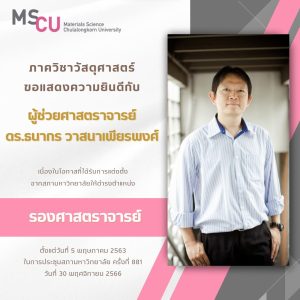
The Department of Materials Science, Faculty of Science, Chulalongkorn University, congratulates Assistant Professor Dr. Thanakorn Wasanapienpong.
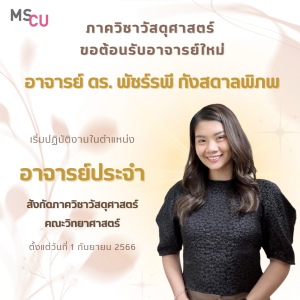
The Department of Materials Science welcomes our new faculty member, Dr. Patcharapee Kangsadarnpipop.
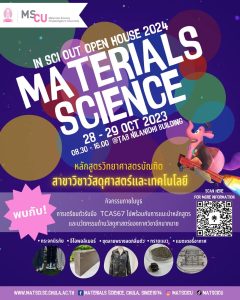
For students who are preparing for TCAS 2024.
Let's get to know the Department of Materials Science, Faculty of Science, Chulalongkorn University in depth. Find out how interesting, worthwhile the studies are, and what amazing career opportunities are available. Learn how to prepare for TCAS67. Visit the Materials Science booth in the lobby of the Taeb Neelani Building on October 28-29, 2023, from 8:30 AM to 4:00 PM.
#MatSciCU
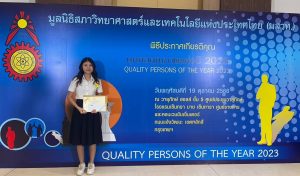
Department of Materials Science Congratulationswith Miss Theetamas Prakmat, a 4th year student of the department, on the occasion of receiving the award. “Quality Youth Scholarship of the Year 2023” as well.
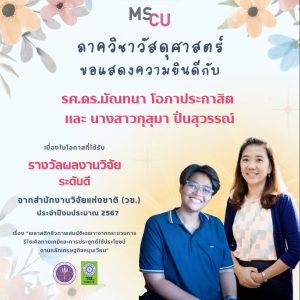
Faculty and students from the Department of Materials Science won outstanding research awards from the National Research Council of Thailand (NRCT).
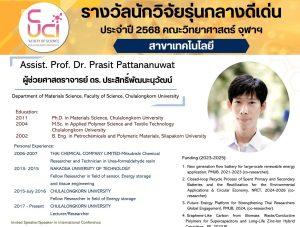
Chulalongkorn University's Faculty of Science honors its outstanding mid-career researcher for 2025 in the field of technology: Assoc. Prof. Dr. Prasit Pattanawat from the Department of Materials Science. A dedicated researcher committed to developing next-generation energy materials to support a clean and sustainable energy future, particularly in the design and development of high-efficiency batteries, supercapacitors, and conductive polymer materials. His research encompasses zinc-ion (Zn-ion) batteries, biomass waste materials, and photo-driven charge technology. He has consistently received national and international research funding and has been invited as a speaker at numerous international academic forums. His notable work includes the design of nanomaterials for safe, environmentally friendly, and industrially applicable energy storage systems. The future of energy begins with the design of smart materials, and this Thai researcher is making it a reality.
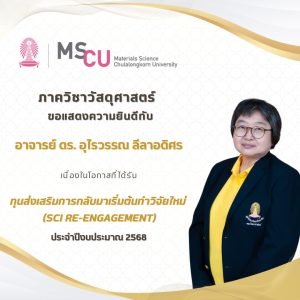
The Department of Materials Science congratulates its faculty members who received awards from the 2025 Research Fund of the Faculty of Science, Chulalongkorn University: Dr. Uraiwan Leelaadisorn for receiving the Sci Re-engagement Grant for fiscal year 2025; Assistant Professor Dr. Prasit Pattanawat for receiving the Outstanding Mid-Career Researcher Award in Technology for 2025; and Associate Professor Dr. Pornnapa Sujaritvorakul.
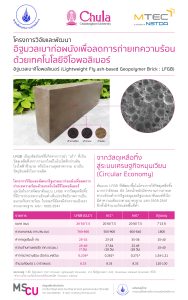
The research and development project for lightweight wall bricks to reduce heat transfer using geopolymer technology focuses on developing innovative production of fly ash-based geopolymer bricks (LFGB) that reuse waste materials.
Geopolymer materials possess properties comparable to cement, but their production process uses lower energy and can be synthesized at room temperature, thus reducing greenhouse gas emissions.

Research conducted by faculty members of the Department of Materials Science, Faculty of Science, Chulalongkorn University, is summarized in the A4 poster below. This allows students, prospective students, and organizations interested in collaboration to learn about the expertise of each faculty member. (A4 poster by MatSciCU) For more research from the department, please visit the Department of Materials Science, Chulalongkorn University research portfolio.
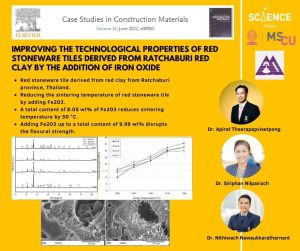
Dr. Apirat Teerapapwisetphong, along with Dr. Siriphan Nilpairach and Dr. Nitiwat Navaakratthanan, researchers at the Institute of Metals and Materials Research, Chulalongkorn University, have developed a technology to improve the properties of red stoneware tiles made from Ratchaburi red clay. Ratchaburi red clay has a high iron oxide content, a unique characteristic of this clay used in pottery making, resulting in high strength. Improving the properties of Ratchaburi clay by selecting the appropriate iron oxide content can lower the firing temperature while resulting in a ceramic body with increased strength and lower water absorption. This is beneficial in considering and specifying the characteristics of red clay raw materials for industrial ceramic production. Read the full article at https://doi.org/10.1016/j.cscm.2022.e00983. See other research.
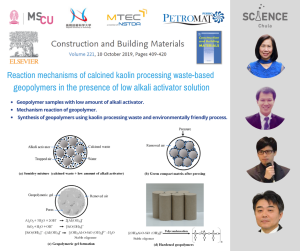
Associate Professor Dr. Sirithan Jiamsirilert and his research team have successfully developed geopolymer materials from waste materials (washed kaolin) using an environmentally friendly preparation process. The use of a low-alkaline activator in the compression molding process promotes more efficient geopolymerization compared to using a high-alkaline solution in the casting molding process. A key advantage of this compressive-weighted geopolymer is its high compressive strength and reduced curing time. A curing time of 7 days (26.98 MPa) is comparable to 28 days (28.55 MPa). This research adds value to waste materials and enhances the potential of domestically produced materials. (Student research)